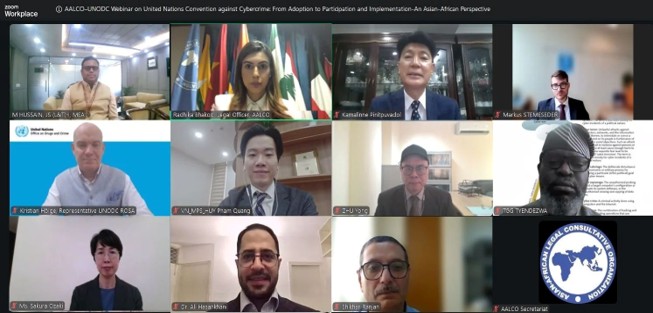
The Asian-African Legal Consultative Organization (AALCO), in joint collaboration with the United Nations Office on Drugs and Crime (UNODC), successfully convened a webinar on “United Nations Convention Against Cybercrime: From Adoption to Participation and Implementation – An Asian-African Perspective” on October 14, 2026.
The Welcome Remarks were delivered by H.E. Dr. Kamalinne Pinitpuvadol, Secretary-General of AALCO, who emphasized that the success of the United Nations Convention against Cybercrime would depend on its effective implementation and practical international cooperation. He recalled AALCO’s longstanding engagement with legal issues in cyberspace, including their inclusion in its Work Programme in 2014, the establishment of a dedicated Working Group in 2015, the “Road to Hanoi” side event in Kampala, and AALCO’s special legal study on the Convention. He noted that 27 AALCO Member States were among the Convention’s 95 signatories, with Ghana, Viet Nam and Qatar among the first to ratify it. Highlighting challenges relating to domestic legislation, institutional capacity, cross-border electronic evidence and human rights safeguards, he reaffirmed AALCO’s commitment to supporting Member States in the effective implementation of the Convention through legal dialogue, knowledge-sharing and international cooperation.
Opening Remarks were subsequently delivered by Mr. Kristian Hölge, Regional Representative of the UNODC Regional Office for South Asia, on behalf of Ms. Monica Yuma, Executive Director of UNODC. Mr. Hölge commended Asian-African Member States for their pivotal contributions throughout the negotiation process within the Ad Hoc Committee (established in December 2019) and noted that the Convention was adopted on December 24, 2024. He underlined the leadership roles played by representatives from People’s Republic of China, the Arab Republic of Egypt, Republic of Indonesia, Japan, Federal Republic of Nigeria, Republic of Singapore, Republic of South Africa, Kingdom of Thailand, and Socialist Republic of Viet Nam. He emphasized that the technology-neutral framework equips law enforcement to tackle both cyber-dependent offenses and emerging cyber-enabled threats and noted on the ongoing work to operationalize the Convention such as preparing draft rules of procedure for the Conference of the States Parties and negotiating a supplementary protocol and urged Member States to participate actively in UNODC’s technical assistance questionnaires regarding ratification readiness and the 24/7 Network.
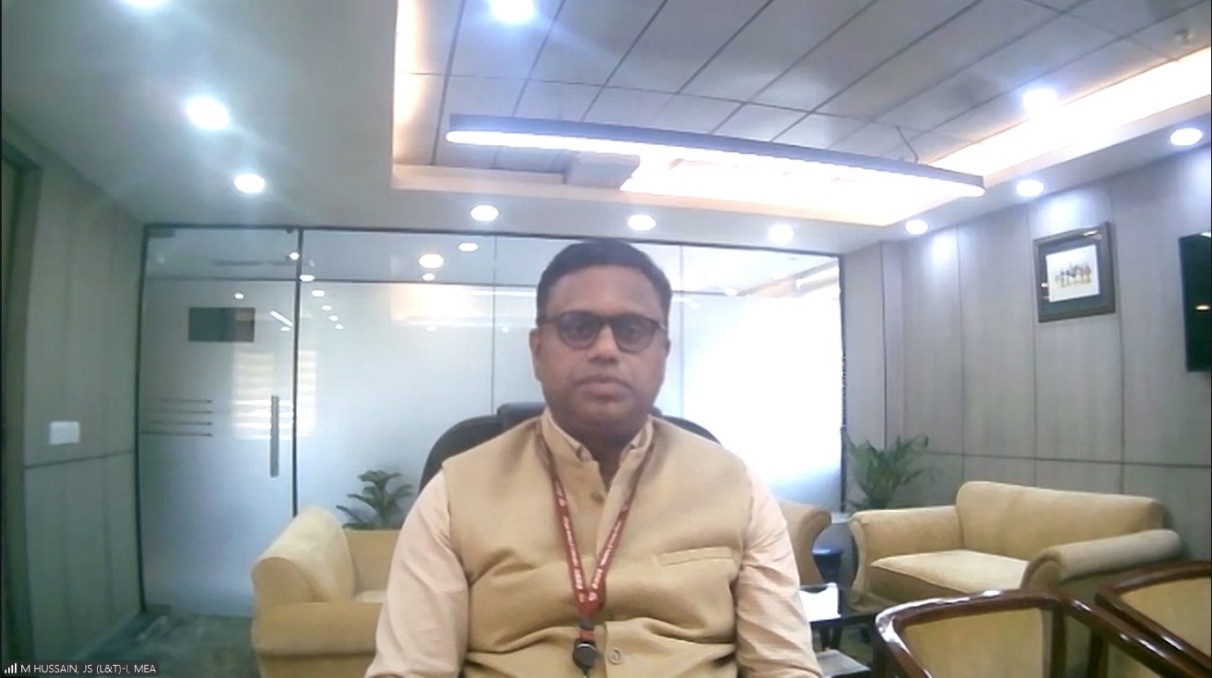
Special Remarks were delivered by Mr. Mohammad Hussain K.S., Joint Secretary, Legal and Treaties Division, Ministry of External Affairs of the Republic of India, the host State of AALCO. Mr. Hussain highlighted India’s position as a major digital economy where Digital Public Infrastructure, electronic commerce, and digital governance are central to national development. Detailing India’s robust domestic legal architecture including the Information Technology Act (2000), the Digital Personal Data Protection Act (2023), and the Bharatiya Nyaya Sanhita (2023) he highlighted Article 37 of the Convention on Extradition as a cornerstone for eliminating safe havens. He further informed that India signed the Convention on September 25, 2026, during the UN General Assembly high-level week in New York. He concluded by emphasizing that effective international cooperation must operate on mutual respect for state sovereignty, jurisdiction, and due process.
The Technical Session featured three distinguished experts who provided an overview of the Convention alongside regional perspectives from Africa and Asia.
Mr. Markus Stemeseder, Associate Crime Prevention and Criminal Justice Officer in the Cybercrime and Technology Section at UNODC Vienna, presented a comprehensive technical overview of the Convention's nine chapters. He detailed its core pillars: the criminalization of cyber-dependent crimes (Articles 7–11) and cyber-enabled crimes (Articles 12–17), as well as a broad procedural framework applying to serious crimes punishable by a minimum of four years’ imprisonment. He covered procedural powers (rapid data preservation, production orders, search/seizure, and real-time data collection), international cooperation mechanisms (MLA, extradition, joint investigations, asset recovery, and the 24/7 Point-of-Contact Network), and human rights safeguards, noting that 40 ratifications are required for entry into force.
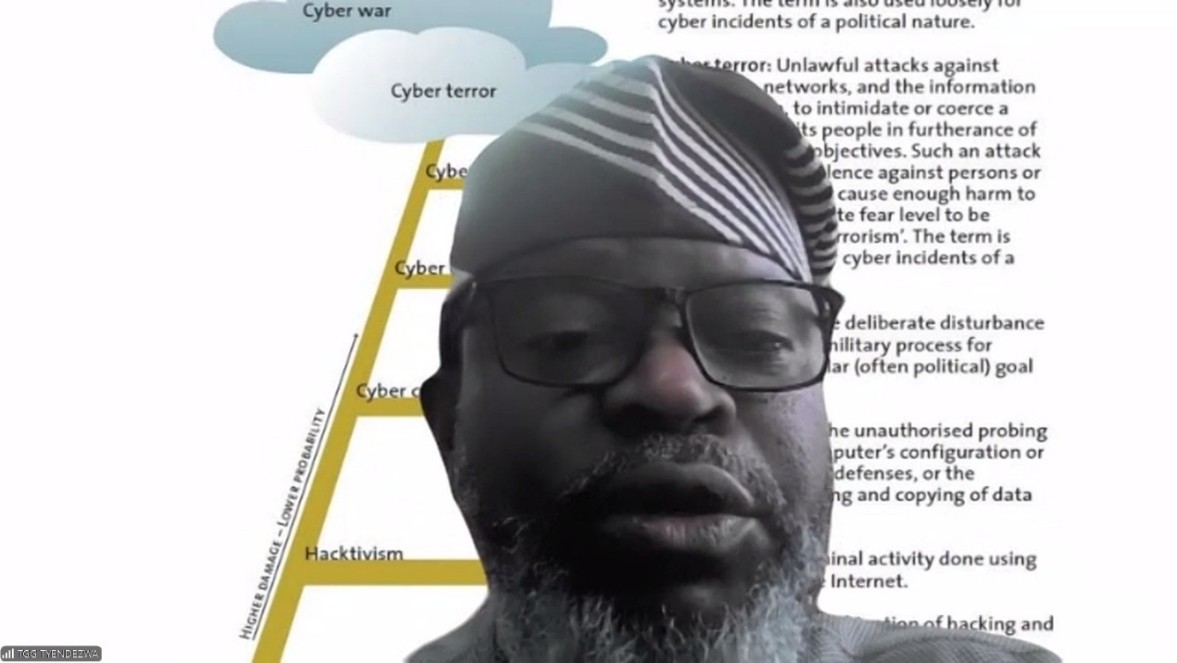
Mr. Terlumun George-Maria Tyendezwa (Federal Republic of Nigeria), Vice-Chair of the Ad Hoc Committee on Cybercrime, presented the African regional perspective. Noting that 22 African nations have signed the Convention, he highlighted four key implementation priorities: modifying domestic statutes to align with both the UN Convention and the AU Malabo Convention, enhancing technical capabilities across the entire justice chain, leveraging bilateral and inter-regional Joint Case Teams (such as the Federal Republic of Nigeria–United Kingdom model) as interim operational mechanisms, and closing enforcement loopholes. He also shared that Federal Republic of Nigeria is actively revising its Cybercrime Act and advancing domestic ratification.
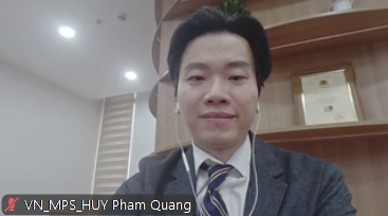
Major Pham Quang Hui, Head of the International Cooperation Team at the Cybersecurity Department, Ministry of Public Security of the Socialist Republic of Viet Nam, presented the Asian perspective. Recalling Vietnam’s honor in hosting the signing ceremony in Hanoi in October 2025 and its rapid ratification in April 2026, Major Hui structured his presentation around cross-border investigative realities, harmonizing domestic legal architectures, and early ratification experiences. He highlighted key domestic legislative instruments (such as the Law on Personal Data Protection, Law on Cyber Security, and Law on Data Security) and institutional achievements, including the groundbreaking ceremony on July 10, 2026, for the headquarters of the Asia-Pacific Regional Counter Cybercrime Hub in Hanoi and a Letter of Intention signed with UNODC in September 2026.
The presentations were followed by an interactive question-and-answer session, during which participants and delegates engaged with the panellists on topics including domestic criminal law harmonization standards, human rights safeguards and grounds for refusal under Chapter V, UNODC’s phased technical assistance models, resolving jurisdictional overlaps during multi-state prosecutions, and optimal institutional structures for Central Authorities and 24/7 Points of Contact.
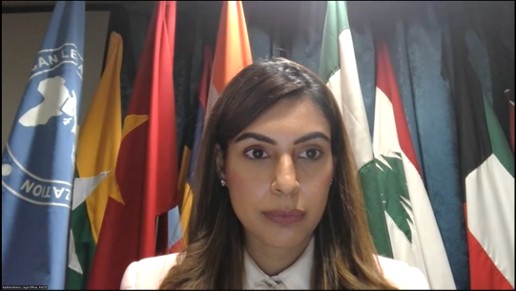
The webinar was moderated by Ms. Radhika Bhakoo, Legal Officer, AALCO Secretariat, while the Vote of Thanks was delivered by Mr. Yong Zhu, Deputy Secretary-General, AALCO.
The event formed an integral part of the intersessional academic and capacity-building activities organized in commemoration of the Platinum Jubilee (70th anniversary) of AALCO.
 |
 |
 |
 |
 |
 |
 |
 |